
Call for Proposals
Proposals Add a proposal to the waitlist
Submission deadline
Proposals close May 15, 2026 at 23:59 CET.
Please get your submissions in on time!
The call for all other proposals is now closed.
If your submission was accepted, everything will be planned via email. Still, we ask that you bring all the materials you will need for your own session, although we will have some basics on hand, such as: pens, pads of paper, white boards, scissors, poster board, etc.
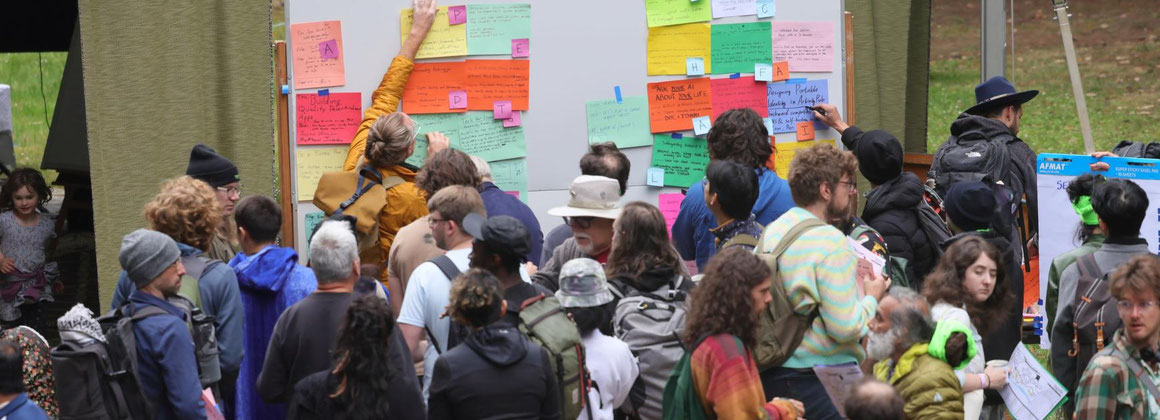
Complex problems require interdisciplinary collaboration to solve. One of the great benefits of DWeb Camp is the chance to weave together many skill sets, experiences and perspectives. So we encourage you to think outside the box! We'd love to see all types of creative activations such as art installations, hands-on demos, readings, games, hackathons, and performances.
You are welcome to talk about a variety of topics, such as a movement you’re involved in, a personal interest, an insight you've had at a past Camp, or sharing the output of your DWeb project. We encourage you to share knowledge and ideas, and discourage product pitches!
You can propose:- lightning talk (10 min presentation + 3 min Q & A)
- workshop (60 or 90 minutes)
- talk or presentation (30 or 60 minutes)
- panel discussion (60 minutes)
- Demo Night Market participation
We'll also have open space available for Unconference conversations at Camp. If you'd like your session to be a part of that, you do not need to submit a proposal. You only need to show up at the start of the Unconference to propose your sessions.
You are welcome to submit multiple proposals, but we encourage you to think deeply about the best offerings for this space. We’re expecting a lot of proposals and will have to make tough decisions on which ones we accept. You can edit proposals after they are submitted before the May 15, 2026 deadline.
Important Dates
| Description | Date |
|---|---|
| Call for Proposals Opens | March 16 2026 |
| Call for Proposals Closes | May 15 2026 |
| Review Period | May 15 - June 8 2026 |
| Final Decision Sent | June 8 - 12 2026 |
| Final Schedule Published | June 22 2026 |
Programming Tracks
Tracks
This year at DWeb Camp, we will have 10 programming tracks to help shape our conversations and create an engaging environment where ideas flourish. We work with curators, usually subject area specialists, to invite diverse speakers and help design these tracks. You can self select a track for your proposal but you don’t need to fit into a track to have a session accepted.
Our tracks this year are:
Anti-Authoritarian Stack
The need has never been greater: how to build resilient network stacks that are resistant to censorship and unaccountable control, enabled through portable and sovereign identity and data.
D:food/web
Cultivating Tech for Food Sovereignty
We bring together the people working on food sovereignty, agroecological tech, cooperative structures, and the stewardship of community land and data.
Nourishment and propagation. What we cultivate together.
Decentralized Design
Top designers demonstrate participatory design that centers usability, accessibility, and ecological impact; the creative practices to build for humans in the real world.
Decentralized Hardware / Local Community Networks
Hands-on experience with peer-to-peer mesh networks and the hardware that meets local communication needs and enables disaster resilience.
Open Social Web
How do we strengthen ecosystems of federated, decentralized, social networks that are interoperable, user-governed, and liberatory?
Peer-to-Peer & Local First
Bringing together global builders focused on interoperability, local-first tools, protocol interaction, and distributed coordination.
Public AI
Strategies for building publicly accessible, accountable, and trustworthy large language models (LLMs) and machine learning systems—AI tools that are collectively governed and work for the common good.
Solidarity Tech
Scale moves in two directions. Exploring network infrastructures built and maintained by/for small trusted communities, designed for intimacy, trust, and safety at a human scale.
Sustaining Infrastructure
Exploring approaches to sustain free/libre/open source decentralized technologies through social solidarity economy practices and other community governance and funding models.
Intergenerational Growth
Seedlings
Children’s Track (under 12 years old)
Activities for children that encourage play, creativity, and enrichment in nature. Examples include storytelling, puppetry, music, movement, chi-gong, and craft-making.
Roots begin in imagination. And seedlings grow strong in nourishing soil.
Saplings
Teen Track (13–17 years old)
Activities for teens that activate young adults to lean into their curiosity and get hands on with new skills.
A space for emerging voices to stretch toward the canopy while still deeply rooted in community.
Old Growth
Pioneers of the Decentralized Web
The cryptographers, protocol designers, organizers, funders, and cultural architects who seeded this ecosystem.
Old growth forests stabilize entire climates. They carry memories forward. They create the conditions for everything else to grow.
Session Types
- Lightning Talk: These are recorded 15 minute sessions: 10 minute presentation + 3 minute Q&A that offer a quick introduction to a story, case study, idea, or technique. There is the option to give a lightning talk in a space with a 60" monitor and electricity.
- Talk/Presentation (30 or 60 minutes): These are structured talks or presenter-style sessions designed to inform the audience about a topic.
- Workshop (60 or 90 minutes): These are interactive demonstration or experiential sessions rooted in audience participation and active learning. Half or more of the time must be dedicated to experiential learning and innovative, active audience participation. Projects or workshops can be as small and transient as a single gathering near a tree, or span multiple hours throughout Camp to explore a theme together from many angles. If you have an idea you're already working on, organizing a project or workshop may be a good way to engage diverse participants and test your assumptions.
- Panel Discussion (60 minutes): A dialogue by multiple speakers or panelists who share perspectives on a topic through conversation with a moderator and time reserved for audience participation, questions, and comments. Short opening remarks by the panelists set the stage for robust discussion with each other and the audience. Panels may include 3-7 speakers and should include varied and unique perspectives on the selected topic. If selecting this type, please specifically address how the different perspectives on the panel will lead to an engaging discussion. Reviewers will pay particular attention to these elements for panel proposals.
- Others: We are excited by out-of-the-box ideas. We love to see activations, art installations, demos, readings, games, hackathons, performances and more.
- Demo Night Market: A stall at the night market where you can demo your tech and participants get a taste of tech from around the world, directly from the decentralized tech stack. This will highlight “ready to test” new tools, no prototypes, so builders can get feedback from hundreds of savvy, deeply interested potential consumers and partners. It’s a great place to find collaborators, funders, recruit builders to your ecosystem, and get honest feedback about your work.
We'll have open space available for Unconference conversations and demos at Camp. Participants typically use meal times and open space for emergent conversations. You can also try the walkshop model where you take your conversation on the road: walk and talk!
Session Criteria
A strong DWeb Camp session is more likely to be selected if it:
Sessions should reflect the values of the decentralized web, including technologies and approaches that uphold human agency, distribute benefits, and enable peer-to-peer relationships.
Read the DWeb Principles here: https://getdweb.net/principles/
The best sessions are interactive and collaborative. Consider formats that involve multiple partners, organizations, or participants and invite the audience to actively contribute rather than just listen.
Sessions should welcome participants with different backgrounds, perspectives, and levels of technical knowledge. Think about how to make complex topics approachable and how to bridge gaps between technical, policy, and community audiences.
We encourage sessions that uplift voices from marginalized communities and include multiple viewpoints. Avoid single-perspective panels; instead, consider bringing together different stakeholders or co-facilitators.
Be mindful of potential biases and structure your session so participants feel comfortable engaging, asking questions, and sharing ideas.
Strong proposals think about what happens next. What outcomes, collaborations, or learnings might continue after DWeb Camp?
Tips for Designing a Great DWeb Camp Session
Use the criteria above as a guide when shaping your proposal. The strongest sessions don’t just describe a problem, they create a space where people can learn from each other and build together.
As you design your session, think about:
How will people engage with each other? Consider formats that invite discussion, collaboration, experimentation, or hands-on learning. Shared exploration
How will you structure the time so people can contribute ideas, experiences, or skills?
DWeb Camp brings together technologists, organizers, researchers, artists, policymakers, and newcomers. How will your session make space for people with different backgrounds and levels of expertise to join the conversation?
Great sessions often generate ideas, connections, and next steps. How might you gather insights, collect feedback, or share what comes out of the session with the broader community?
Finally, please help create the spirit that makes DWeb Camp special: encourage participants to engage with respect, kindness, and curiosity.
Our Review and Selection Process
The call for all other proposals is now closed. Submissions closed on May 15, 2026. A team of DWeb organizers and curators is reviewing proposals from May 15–June 8, 2026. This gives the organizing team time to review session proposals and make necessary arrangements.
If your submission was accepted, everything will be planned via email. Still, we ask that you bring all the materials you will need for your own session, although we will have some basics on hand, such as: pens, pads of paper, white boards, scissors, poster board, etc.
We work with curators, usually subject area specialists, to invite diverse speakers, and go through the proposals that you submit. We typically receive a high volume of submissions. So, to streamline the process and create a more impactful event, we strongly encourage facilitators with similar ideas to collaborate with each other. We hope to accommodate as many sessions as possible but with limited time slots available, it might be necessary to merge proposals.
Final decisions will be sent June 8-12, 2026. A member of the team will be available to support any revisions, space or logistical requests you might have. After your proposed talk or workshop is confirmed, it will be listed in the schedule. We aim for the final schedule to be published by June 22, 2026.
Don't forget to buy tickets to Camp before spots run out!
Proposal FAQs
When are proposals to present at Camp due?
The call for all other proposals is now closed. The call was open from March 16 through May 15, 2026 (23:59 CET).
What kinds of sessions can I propose?
You can propose:
- lightning talk (10 min presentation + 3 min Q & A)
- workshop (60 or 90 minutes)
- talk or presentation (30 or 60 minutes)
- panel discussion (60 minutes)
- demo night market participation
DWeb Camp is really about the question: What can I bring? Outside of these typical sessions and presentations, we encourage you to think outside the box. We love to see activations, art installations, demos, readings, games, hackathons, performances and more.
What can I talk about? Is anything off limits?
You are welcome to talk about a variety of topics, such as a project you are involved in, a personal interest, an insight you've had at a past Camp, or sharing the output of your DWeb Project. We encourage you to share knowledge and ideas, not pitch products!
Is everything at Camp scheduled?
No! In fact some of the best conversations at Camp are off-the-cuff or with the person sitting next to you at meal times. We'll also have open space available for Unconference conversations and demos at Camp. If you'd like your session to be a part of that, you do not need to submit a proposal. You only need to show up at the Unconference Sessions.
Do I have to submit just one proposal?
You are welcome to submit multiple proposals, but we encourage you to think deeply about the best offerings for this space. We are expecting a lot of proposals and will have to make tough decisions on which ones we accept. We advise no more than three submissions. You could also edit proposals after they were submitted before the May 15, 2026 deadline.
What makes a proposal likely to be selected?
A strong DWeb Camp session is more likely to be selected if it:
- Aligns with DWeb Principles
- Encourages participation
- Is inclusive and accessible
- Centers diverse perspectives
- Creates a welcoming environment
- Extends beyond the camp
When will I hear back about my proposal??
Final decisions will be sent June 8-12, 2026
What happens after I submit my proposal?
After submissions close, a team of DWeb organizers and curators will review from May 15-June 8, 2026.
We work with curators—usually subject area specialists—to invite diverse speakers, and go through the proposals that you submit. In a certain track, they fit all the accepted proposals into the Morning and Afternoon Sessions (3 hours each, for three days: Thursday, Friday, and Saturday). You don’t need to fit into a track to have a session accepted.
We typically receive a high volume of submissions. To streamline the process and create a more impactful event, we strongly encourage facilitators with similar ideas to collaborate with each other. We hope to accommodate as many sessions as possible but with limited time slots available, it might be necessary to merge proposals.
Final decisions will be sent June 8-12, 2026. A member of the team will be available to support any revisions, space or logistical requests you might have. After your proposed talk or workshop is confirmed, it will be listed in the schedule. We aim for the final schedule to be published by June 22, 2026
What kind of amenities and space options will I have?
There are more slots for sessions that don’t require electricity, or monitors. Your session is more likely to be accepted if you can gather anywhere with limited equipment. However, when you submit your proposal you can let us know if you need any of the following:
- Electricity (power plugs and sockets)
- Video monitor
- Internet connectivity
- Writing pad
- Table and chairs
- On the ground seating is fine
- Outdoors or indoors is fine
- Outdoors with power
- Circle seating is fine
- Classroom style row of chairs facing presenter
- Classroom style row of chairs and tables
- theatre/auditorium/amphitheatre
- Comfy cozy: pillows, bean bags, etc.
Are there tracks at DWeb Camp 2026 and can I be a part of any track?
Yes, there are tracks and curators this year at DWeb Camp 2026. We work with curators, usually subject area specialists, to invite diverse speakers and help to design these tracks. You can self select a track for your proposal but you don’t need to fit into a track to have a session accepted. The tracks this year are:
- Anti-Authoritarian Stack
- Decentralized Design
- Decentralized Hardware/ Local Community Networks
- Folk Tech & the Cozy Web
- Open Social Web
- Peer-to-Peer & Local First
- Public AI
- Sustainable Infrastructure
- Tech for Food Sovereignty
- Intergenerational Growth: Seedlings is the Children’s Track (Under 12), Saplings is Teen Track (13-17 years old) and Old Growth is for the pioneers of the Decentralized Web. If you like to, you can do a special presentation/workshop or version of your proposal for these tracks.
What is the Demo Night Market?
Imagine a night market of stalls where you can get a taste of tech from around the world, directly from the decentralized tech stack. We’re highlighting “ready to test” new tools (no prototypes please!), so builders can get feedback from hundreds of savvy, deeply interested potential consumers and partners. It’s a great place to find collaborators, funders, recruit builders to your ecosystem, and get honest feedback about your work. We are looking for tools that are “consumer ready”. People shouldn’t need to know how to code to use it. It’s best if they don’t have to download anything to use it. To be part of this, select the box and fill in the required information in the form.
Still have questions? Check out the FAQs here, email [email protected] or ask at one of our Pre-Camp Info Sessions.
Join the Conversation
| Sign up to receive updates by email | |
| #dwebcamp-2026:getdweb.net (More info) | |
| @[email protected] | |
| @getdweb.net | |
| @GETDWeb | |
| [email protected] |